

Description
Donatas Jonikas – Double Sprint Method Masterclass Review: Pros, Cons, and Final Verdict
Many startup founders and innovation teams waste months—and tens of thousands of dollars—building products that nobody buys. The primary culprit is sequential execution: spending months refining technology and code before exposing the value proposition to actual paying customers.
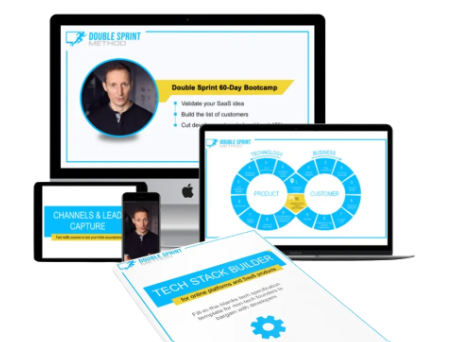
The Double Sprint Method Masterclass—created by Dr. Donatas Jonikas, author of Startup Evolution Curve—targets this disconnect. Grounded in research across more than 1,000 startups worldwide, Jonikas provides a structured framework that runs Product Development and Customer Validation in simultaneous, synchronized sprints.
This review examines the mechanics of the Double Sprint framework, core curriculum components, pros, cons, and final verdict.
What Is the Double Sprint Method Masterclass?
The Double Sprint Method is a dual-loop framework that synchronizes technical build stages with marketing, messaging, and sales experiments. Rather than completing an MVP before testing sales copy, founders run two parallel tracks (Technology and Business) through a 10-step infinity loop.
Core Philosophy: Never build a feature without simultaneously testing the customer’s willingness to pay for the problem that feature solves.
Traditional Linear Startup Approach:
[Build Full MVP] ➔ [Launch Product] ➔ [Attempt Marketing] ➔ [Low Conversion & Pivot Chaos]

Double Sprint Simultaneous Approach:
[Product Specs]  ➔ [Wireframes] ➔ [Feature Set] ➔ [Cost Estimates]
       │                 │              │                │
[Customer Loop]  ➔ [Discovery]  ➔ [Pre-Sell]   ➔ [Proven Product Spec]
Key Features and Core Components
1. The Infinity Loop Framework
The framework synchronizes 10 technical steps (from initial specifications to UI wireframes) directly with 10 business steps (from discovery interviews to pre-selling experiments). This ensures product decisions respond directly to real customer feedback.
2. Market-Proven Product Specifications (MPPS)
Instead of relying on guesswork, Jonikas teaches how to build a Market-Proven Product Specification. This acts as a blueprint that developers can execute with confidence, backed by quantified demand metrics.
3. Pre-Selling & Demand Validation Playbooks
The masterclass details how to validate offer demand using landing page experiments, lead capture setups, and pre-order frameworks before writing production-grade code.
4. Data-Driven Decision Rules
The masterclass includes practical checklists and metrics to determine whether to pivot, persevere, or stop, taking emotional bias out of product validation.
Program Specifications & Overview
| Evaluation Vector | Details |
| Creator | Dr. Donatas Jonikas (PhD in Marketing, Author of Startup Evolution Curve) |
| Foundation | Empirically derived from research analyzing 1,000+ global startups |
| Core Framework | Parallel Product-Customer Infinity Loop (10 dual-track steps) |
| Primary Audience | Early-stage founders, product managers, innovation leads, startup mentors |
| Core Deliverables | Video modules, interactive templates, validation playbooks, pre-sell setups |
Pros: Where the Program Excels
-
Evidence-Based Methodology: Built on empirical research analyzing over 1,000 startups, avoiding unproven “guru” anecdotes.
-
De-Risks Development Spend: Forces pre-sale validation early, preventing teams from burning budgets on unwanted features.
-
Clear Alignment for Co-Founders: Provides a shared framework for technical co-founders (Product loop) and business co-founders (Customer loop).
-
Actionable Templates: Includes plug-and-play templates for customer discovery interviews, landing page copy, and value proposition testing.
Cons: Where It Might Fall Short
-
Requires Disciplined Execution: Simultaneous tracking across two workflows requires strict task management and co-founder communication.
-
Not for Pure B2C Mass Market Apps: Highly complex hardware or consumer hardware startups may need to adjust the pre-selling timelines.
-
Requires Comfort with Early Outreach: Founders hesitant to talk to customers or run pre-sell tests will hit a execution barrier early on.
Comparison: Lean Startup vs. Double Sprint Method
| Evaluation Vector | Lean Startup (Build-Measure-Learn) | Double Sprint Method |
| Primary Workflow | Build MVP first, then test in market | Run Product and Customer tracks in parallel from day 1 |
| Validation Point | Post-launch user metrics | Pre-launch willingness-to-pay & pre-sales |
| Operational Guidance | High-level philosophical framework | Tactical 10-step step-by-step infinity loop |
| Dev Budget Risk | Moderate (builds MVP before learning) | Very Low (validates value before coding) |
Who Is This Program Best For?
-
Early-Stage Founders: Entrepreneurs sitting on a new product idea who want to validate demand before hiring engineers.
-
Technical Co-Founders: Developers who want clear, validated requirements before committing code to production.
-
Corporate Innovation Teams: Venture builders needing a repeatable methodology to audit and de-risk new product bets.
Is the Double Sprint Method Masterclass Worth It?
If you are looking for basic “how to pitch investors” advice or quick-fix growth hacks, this masterclass is over-engineered for those needs.
However, if you want a research-backed, disciplined methodology to validate customer demand and build products people will pay for, Dr. Donatas Jonikas’ Double Sprint Method Masterclass provides an invaluable blueprint.
Final Verdict
The Double Sprint Method Masterclass offers a practical evolution of traditional Lean Startup principles. Synchronizing product development with customer validation delivers one of the most effective frameworks available for reducing early-stage startup risk




Reviews
There are no reviews yet.