
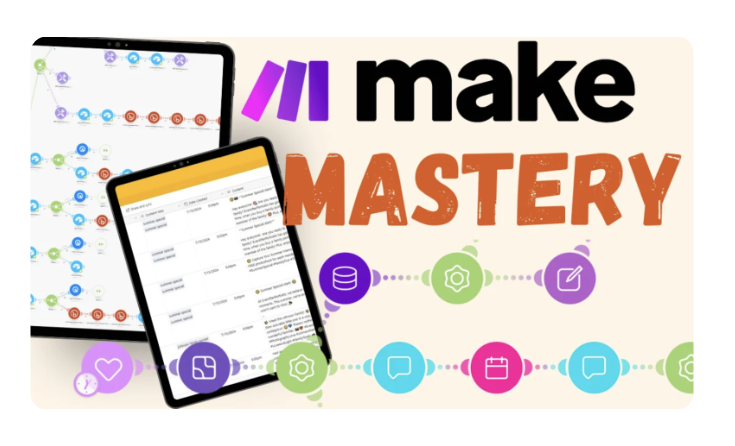

Description
Mitch Baylis – Make.com Advanced Business Automation Course Review: Is It Worth It?
Modern digital operations run on speed and connectivity. As organizations integrate dozens of software tools—from CRMs like HubSpot and Salesforce to payment gateways, databases, and AI models—managing manual data entry becomes an expensive operational bottleneck.
While basic automation platforms handle simple trigger-action routines, scaling a business requires enterprise-grade logic. This is where Make.com (formerly Integromat) excels, providing visual visual-building capabilities for complex data handling.
Mitch Baylis – Make.com Advanced Business Automation Course is designed specifically for teams, founders, and automation engineers looking to move past beginner-level tutorials. This review provides an in-depth, honest look at the curriculum, key modules, practical applications, drawbacks, and overall ROI.
What Is the Mitch Baylis – Make.com Advanced Business Automation Course?
The Mitch Baylis – Make.com Advanced Business Automation Course is a structured, master-level training program tailored for non-developers and technical operators alike. Rather than teaching basic, linear triggers (e.g., “when a form is submitted, send an email”), this program focuses on building self-healing, multi-branch, and high-throughput automation architectures.
Instructor Mitch Baylis walks students through real-world business scenarios, detailing how to manipulate complex data payloads, handle API calls natively, and construct reliable error-handling systems.
Basic Linear Automation:
[Trigger App] ➔ [Simple Action App] (Fails if data structure changes)

Advanced Business Architecture:
[Webhook Ingestion] ➔ [Data Parsing & Validation] ➔ [Routers / Filters] ➔ [Parallel API Requests] ➔ [Error Handling & Fallbacks]
Core Modules and Technical Curriculum
1. Advanced Data Structures: Arrays, Iterators, and Aggregators
The core engine of Make.com lies in how it parses complex JSON payloads. This module breaks down how to take large datasets, split them using Iterators, perform transformations, and stitch them back together using Aggregators without exceeding operation limits.
2. Complex Logic, Routers, and Conditional Filters
Scaling operations requires dynamic routing. Students learn to implement multi-path Routers guarded by advanced string, numeric, and boolean Filters. This ensures that data flows only where intended, minimizing unnecessary operation usage and preserving monthly quotas.
3. Native API Calls & Custom Webhooks
When standard pre-built modules fall short, custom integrations are required. The course teaches students how to configure custom HTTP requests, manage authentication headers (OAuth2, API Keys, Bearer Tokens), and parse raw responses directly within Make.com scenarios.
4. Enterprise Error Handling and System Resilience
In production environments, scenario crashes mean lost revenue. This module covers advanced error-handling directives—including Ignore, Break, Resume, and Commit—ensuring that automation runs reliably even when third-party software experiences downtime.
What Makes This Course Stand Out?
-
Operator-Focused Architecture: Focuses on real-world utility—such as custom CRM syncing, automated financial reporting, and scalable onboarding funnels.
-
Cost & Operation Optimization: Teaches efficiency techniques to prevent scenario bloatedness, directly saving money on monthly Make.com operational plans.
-
Deep Mechanics Over Basic UI: Moves beyond surface-level button pushing into the mathematical and logical fundamentals of data processing.
-
Self-Healing Scenarios: Heavy emphasis on building fail-safes so automated systems recover without manual intervention.
Potential Cons to Keep in Mind
-
Steep Learning Curve for True Beginners: If you have never built a basic automation scenario, the rapid introduction of data arrays and JSON structures can feel overwhelming.
-
Requires Active Sandbox Testing: The course is hands-on. Watching videos passively without building along in a live Make.com environment limits skill retention.
-
Third-Party Tool Costs: Implementing full enterprise automation flows may require paid API access or subscriptions to sandbox applications.
Comparison: Basic Tutorials vs. Advanced Business Automation
Who Should Enroll in This Program?
-
Operations Managers & COOs: Leaders seeking to eliminate operational drag, reduce human error, and connect fragmented tech stacks across their company.
-
Freelancers & Automation Consultants: Technical service providers wanting to charge higher retainers by offering custom API builds and complex systems.
-
No-Code / Low-Code Developers: Builders looking to expand their skill set beyond standard tools and engineer custom backend workflows.
Final Verdict
The Mitch Baylis – Make.com Advanced Business Automation Course is a definitive, high-ROI masterclass for anyone serious about mastering no-code backend operations. By focusing on structural efficiency, API integrations, data transformations, and error resilience, it provides the exact skills needed to build robust, enterprise-grade business automation.
If you are ready to transition from simple integrations to complex operational engineering, this training is an exceptional investment.



Reviews
There are no reviews yet.