
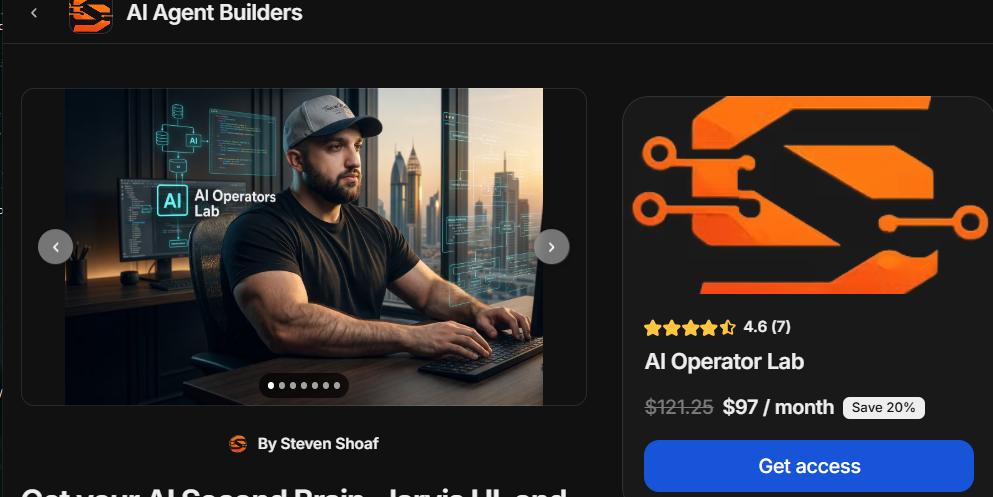

Description
Steven Shoaf – AI Operator Lab Review: Pros, Cons, and Final Verdict
Artificial intelligence is undergoing a massive shift. The era of simply copying basic text prompts into ChatGPT or asking an AI to write a blog post is rapidly fading. Modern businesses and operators require autonomous workflows, centralized context storage, and agent-driven infrastructure capable of running complex operations behind the scenes.
Steven Shoaf – AI Operator Lab was created to serve as a practical build hub for marketers, developers, and technical operators who want to transition from basic AI prompting to full-scale systems implementation. Hosted as a build-focused community and repository hub, the program drops real working code, custom command-center interface patterns, and agent framework templates.
This review covers what the platform offers, its key features, the pros, the cons, and whether it is truly worth your hard-earned investment.
What Is Steven Shoaf – AI Operator Lab?
Steven Shoaf – AI Operator Lab is a hands-on implementation environment designed for digital builders who want to construct custom AI operator systems. Created by developer and AI strategist Steven Shoaf, the lab focuses heavily on operational code drops, system architecture, and production-ready setups.
Instead of teaching broad conceptual theory, the program gives members direct access to usable codebases, framework blueprints, and step-by-step setup walkthroughs. The core focus is turning fragmented AI tools into a single, cohesive operator stack.
Traditional AI Usage:
[Single Chat Interface] ➔ [Isolated Prompt] ➔ [Manual Data Copy-Paste] ➔ [Fragmented Output]

The Operator Lab Approach:
[Unified Command Center (Jarvis UI)] ➔ [Shared Memory / Second Brain] ➔ [Autonomous Agent Execution] ➔ [Integrated Output]
Key Features of the Program
1. Second Brain & Shared Memory Architecture
A major issue with standard AI setups is context loss across sessions. The lab provides Obsidian-based workflows and custom memory systems designed to store long-term business context, project blueprints, and dynamic execution prompts, allowing your AI infrastructure to stay aligned over time.
2. Jarvis UI & Command-Center Layouts
The program shares custom dashboard designs and frontend interfaces built for managing multiple AI agents concurrently. Rather than navigating multiple browser tabs, users learn how to consolidate agent controls into a single command center.
3. OpenClaw & Agent Workflows
Members receive access to custom agent skills, prompt structures, and configuration files designed to deploy autonomous tasks. These setups can execute back-office operations, handle data processing, and perform multi-step web tasks without constant human intervention.
4. Direct Code Drops & Templates
The community regularly drops source code, scripts, and production blueprints for lightweight SaaS features, AI assistants, and automation pipelines. This allows builders to copy, adapt, and deploy operational systems rapidly rather than starting from scratch.
Pros: Where the Program Excels
-
Production-Focused Content: Skips surface-level marketing fluff and delivers functional code, architecture patterns, and technical execution files.
-
Solves Context Fragmenting: The focus on Shared Memory and Obsidian integration gives AI setups true persistent context for complex business operations.
-
Accelerates Development Speed: Pre-built templates, UI layouts, and agent skills allow operators to deploy custom builds in days rather than weeks.
-
Active Builder Community: Connects technical operators, freelancers, and agency founders who actively debug, share improvements, and test new agent frameworks.
-
High Real-World Utility: Equips service providers and agency owners with distinct technical assets they can sell directly to clients as high-ticket implementations.
Cons: Where It Might Fall Short
-
Technical Entry Barrier: This is not a zero-experience course. Users with no prior coding, API, or local environment experience may face a steep learning curve.
-
Requires Setup Maintenance: Custom agent stacks and developer-centric workflows require manual updates as underlying API models evolve.
-
Not a “Push-Button” Solution: Members must actively deploy, configure, and maintain code bases within their own environments.
-
Additional API Expenses: Running multi-agent architectures and high-frequency context retrieval incurs third-party API costs from AI providers.
Comparison: Generic Training vs. AI Operator Lab
Who Is This Program Best For?
-
Technical Agency Owners: Service providers looking to build and deploy custom AI agent infrastructure for high-ticket client retainer contracts.
-
Freelancers & Developers: Engineers wanting to accelerate their development workflow using pre-tested code bases and UI templates.
-
Operations Managers & Founders: Business leaders needing a centralized, autonomous system to manage internal documentation, data extraction, and workflow automations.
It is less suitable for absolute beginners looking for basic non-technical explanations or passive video-only courses.
Is Steven Shoaf – AI Operator Lab Worth Your Investment?
Whether this platform is worth your money depends on your technical comfort level and immediate business objectives.
If you are looking for generic AI tips or basic text generation ideas, this program will likely feel too technical and complex. However, if you are a technical operator, developer, or agency owner looking to bypass months of trial-and-error by deploying real code drops, Jarvis UI layouts, and persistent agent architectures, the value proposition is exceptional. Saving even ten hours of architecture design or code debugging makes the investment easily worthwhile.
Final Verdict
Steven Shoaf – AI Operator Lab is an outstanding resource for technical builders ready to move beyond basic chatbot interaction. By focusing on code-level implementations, persistent context infrastructure, and custom command centers, it provides a high-leverage toolkit for building modern, production-grade AI systems.




Reviews
There are no reviews yet.